It was an
early morning call to come to the front desk for
face check this morning. We were told that there
may be a five thirty call but it was more like 6
o'clock. It didn't matter to me as I had been
awake for hours. A German ship docked next to us
and they had to go through the same. It seems
that Hungary belongs to some kind of commerce
union with some countries and they can move
freely between them. Coming from Serbia it was a
different story. We also thought that since
Serbia doesn't belong to the European Union they
were making it extra difficult. We have traveled
through four other countries and there was no
trouble...they stamped our passports with out
seeing us. This was quite different. As it was
early, people came with a face check with Jammys
and no make-up. The Customs guy had to give them
an extra hard look. He seemed to be having
trouble scanning mine and it did make me a
little nervous but then he let me pass.

The next thing... don't miss breakfast for
goodness sake, the four guides talked about
their experiences during communism. Irina said
she was only five years old, but she and her
cousins were afraid to go to church and there
was only Father Frost who brought them an orange
and a green banana at Christmas. She said the
children were all told if they waited and didn't
eat them right away the bananas would turn
yellow, but she could never wait that long. All
the others said the same thing. It was many
years before they saw a yellow banana. When her
mother took her shopping for clothes there were
always two styles and two colors of dresses. She
remembers there was only animal soy and salami
for meat protein and her grandmother would wait
in lines for it. It reminded me of Cristina's
telling about her visit to Cuba. Some times the
lines were as long as six or seven hours and the
saying was if you see a queue go stand there as
maybe they will be selling something.
The communist TV showed only two not-communism
shows and they were very popular: Dallas, and
M.A.S.H.... They said all Americans might have
big houses and long driveways but they were all
mean and they had affairs, poor morals, and were
like JR and Sue Ellen and that wasn't good! Of
course secretly the people wished for it and it
did not have quite the effect the communist
leaders thought it would. Instead everyone
wanted blue jeans. If you had those or canned
cigarettes you could get anything on the black
market. They showed M.A.S.H to show what a bad
army Americans had... not nearly as good as
Romania's. Of course they made everyone believe
that Romania was the very best life available in
the world.
Stevans, another Romanian, said that before
communism his family had been very wealthy. His
uncle was a dentist and often took his pay in
art. He was an art collector of many famous
artists in the early time. When communism came
he was made to "donate" that art to the party.
After communism failed what hadn't been sold was
put in the Romanian Art Museum with a little
sign that said donated by... his uncle's name.
No way for the family to get even one returned
to them!
Irina had a communism joke. She said that
Ceausescu was always wanting his picture on
everything. In later times he decided he wanted
his picture on the postage stamps. After some
time he went into a store that was selling the
stamps and asked the lady, how were the sales on
his new stamp. Very meekly she said, "Not too
good; people tell me they don't stick to the
envelope!" "Impossible!" he said, "Give me a
stamp I will show you!" He grabbed the stamp,
licked it and sure enough it stuck tight to the
envelope! " Oh," she said, "Usually they spit on
the OTHER SIDE!"
Bujana, another guide's experience was quite
different. She was from Serbia and she said most
older people feel they were better off during
Tito's time. At least people had a job and some
security. She herself had the best passport
during Tito's time. Of course Tito said "No!" to
Russia and so it was then socialism not
communism. She said her parents and grandparents
were always so sad that her life was not better
than theirs. People like to think their children
will have a better life. After she got through
with her Masters she put out over 200
applications but they were not accepting people
anywhere.. no jobs anywhere. She said she
finally decided to use her neighbor's influence
to get this job. She is very happy being a guide
even though she has been a Spanish teacher and
speaks many languages!
Another guide told about the conflicts in
Hungary. His grandfather was sent to Siberia as
a POW. Ninety percent of them died. They were
given bread and tried to make soup out of it to
make it stretch. They were under communism from
1945 to 1989 except for 2 weeks of the Hungarian
uprising. He remembered the Russian soldiers
everywhere. He wanted a soldier's vest and saved
for months to buy cigarettes to trade for the
vest. His mom still has it. They answered many
questions and then it was LUNCH, Are you seeing
a pattern here?
 After
lunch we went on a great trip to an Hungarian
Horse Farm. It was amazing! As the bus came up
the long drive we were met by one of the
horsemen. He wore a blue Hungarian gaucho outfit
that looked a lot like the ones the Argentina
gauchos wear. He was riding a beautiful black
horse and cracking the whip above his head. The
horse never shied away from the whip as the whip
never touched him. It is just that the end of
the whip is breaking the sound barrier.
After
lunch we went on a great trip to an Hungarian
Horse Farm. It was amazing! As the bus came up
the long drive we were met by one of the
horsemen. He wore a blue Hungarian gaucho outfit
that looked a lot like the ones the Argentina
gauchos wear. He was riding a beautiful black
horse and cracking the whip above his head. The
horse never shied away from the whip as the whip
never touched him. It is just that the end of
the whip is breaking the sound barrier.
We were served
their homemade wine or apple juice and bread
with paprika mixed with lard! I know it sounds
disgusting but it really wasn't that bad. They
had a beautiful huge farm with at least forty
horses, Hungarian white cattle... Google that
one... curly horned sheet and curly pigs! They
had the cutest black donkey that was the clown
of the show and as the guy rode him it reminded
me of the Hodja stories. One guy played a few
Hungarian musical instruments out in the field
and then the show began.

Six of them
galloped around cracking the whip over their
horses heads. The horses laid down with the
horseman laying on top of them...

...and then...
surprise! The horses sat up like a dog on their
back haunches! I have NEVER seen such a thing,

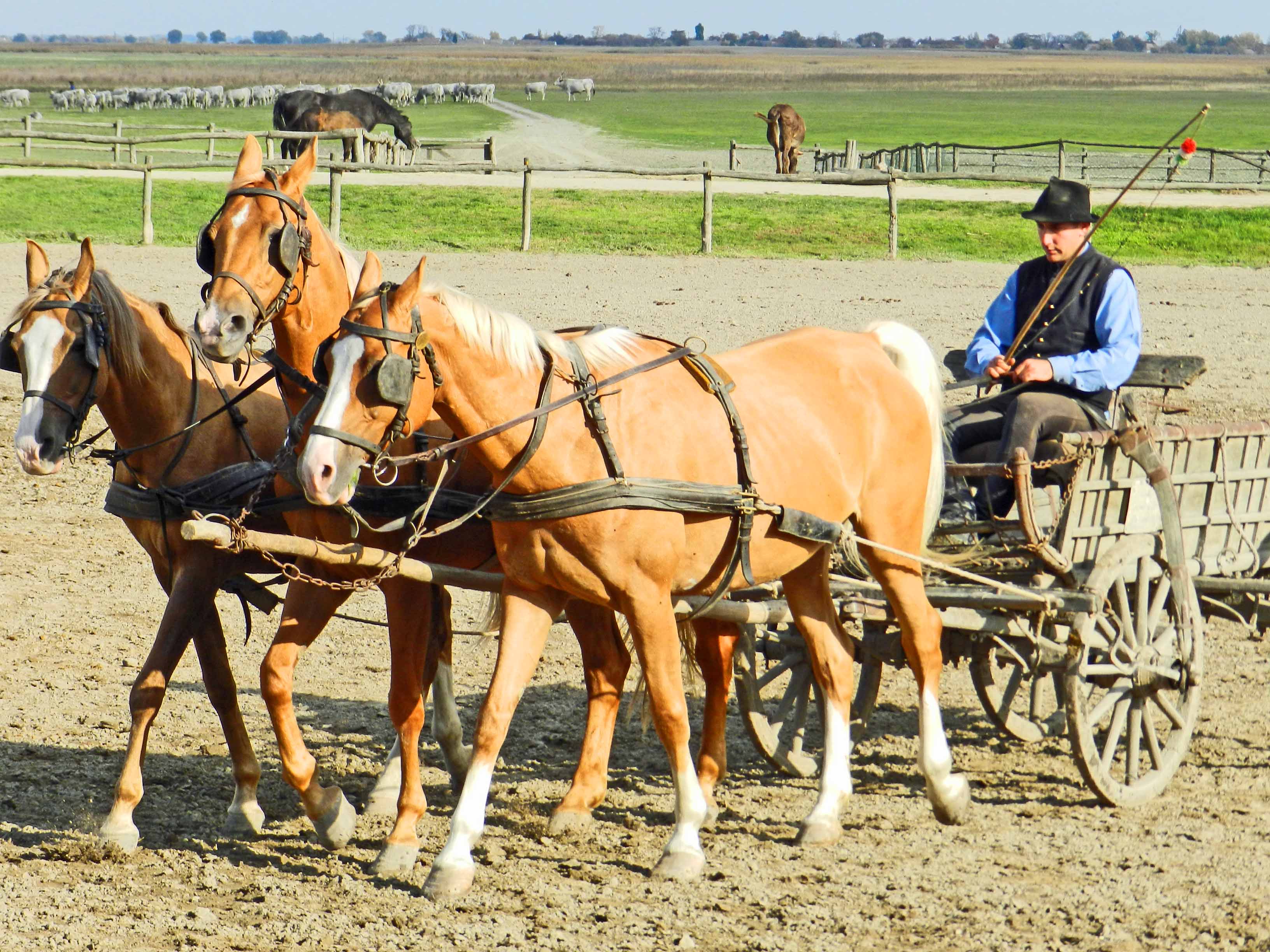
They had three
palomino-like horses that galloped as they
pulled an antique wagon. At times they went so
fast I worried about the guy in the rickety
wagon.
Then they'd
had six beautiful black horses that galloped
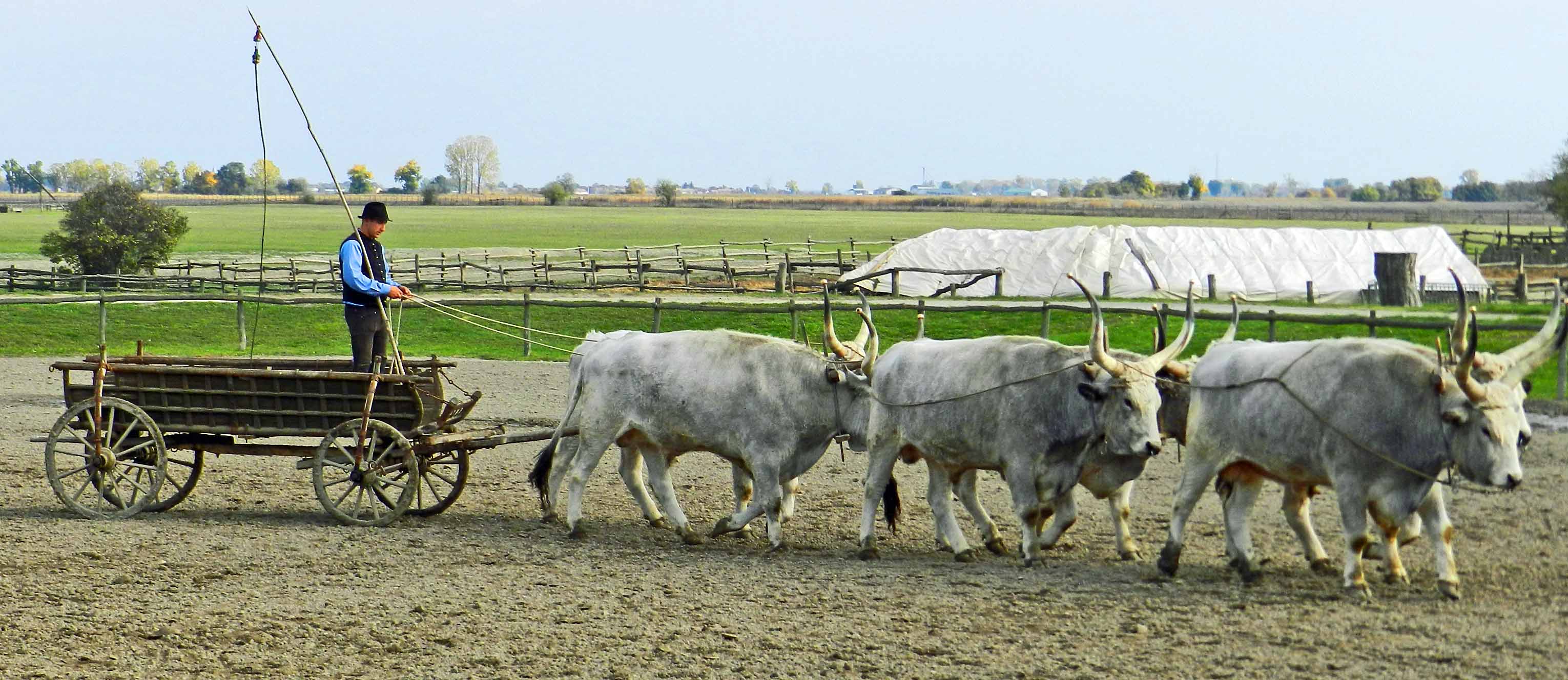
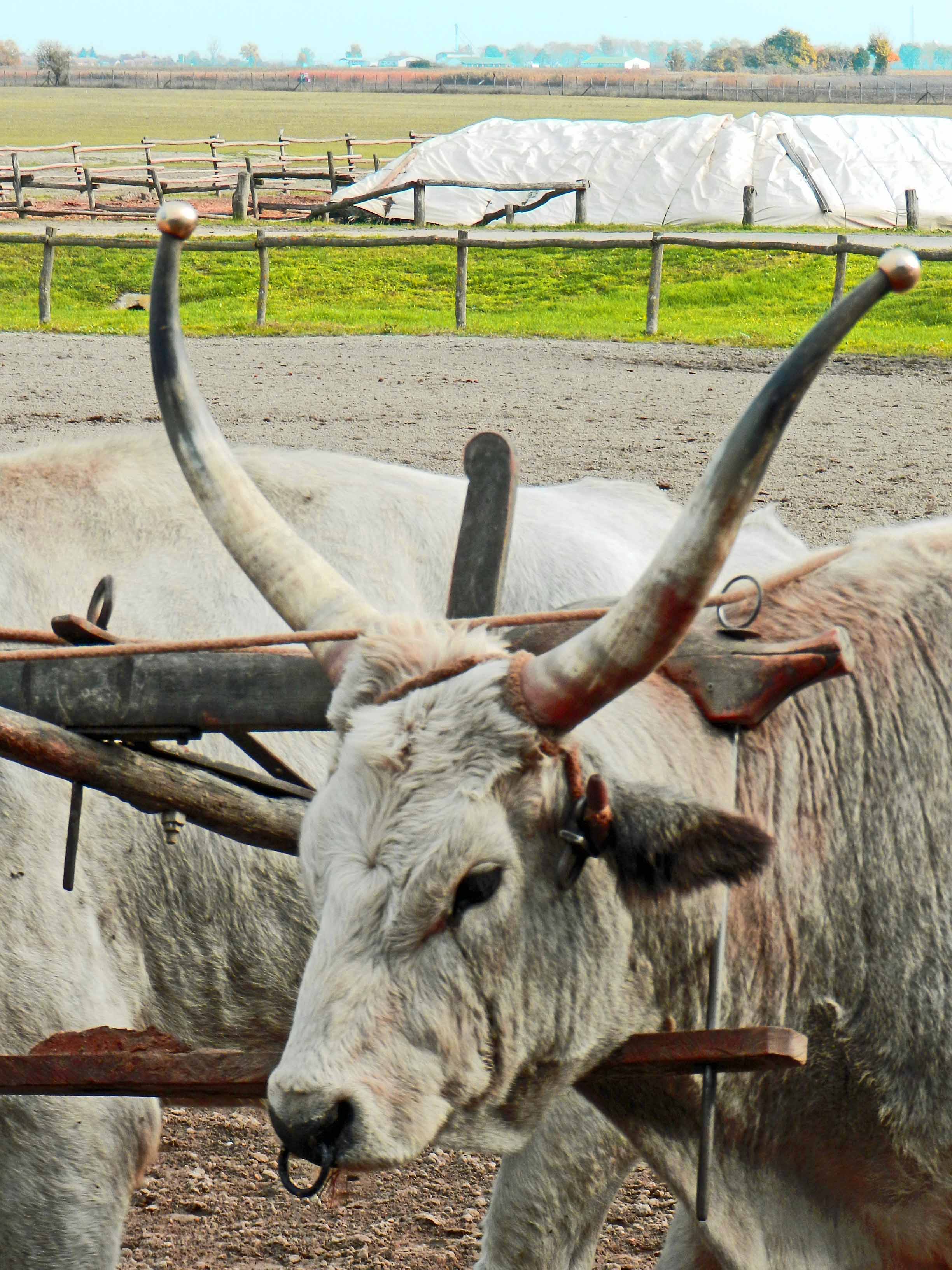
with a black carriage. Six white Hungarian cows
(oxen?) pulled a heavy cart and maneuvered
slowly around the arena.
 The
gauchos sat on their horses while they knocked
down bowling pins with the crack of their whip.
Next the gauchos played a game of "steal the
scarf". They would go as fast as the horses
could possibly go maneuvering and dodging so as
to steal the scarf off the neck of the rider
that has it. It looked very dangerous! It is
something often done in competitions. We toured
the barn, then took a carriage ride out to the
well in the field for more music, more wine and
watched the guy with the donkey corral the white
cows. After our carriage ride back there was
paprika to buy if we wished and some postcards.
It was the most interesting horse show ever! So
entertaining!
The
gauchos sat on their horses while they knocked
down bowling pins with the crack of their whip.
Next the gauchos played a game of "steal the
scarf". They would go as fast as the horses
could possibly go maneuvering and dodging so as
to steal the scarf off the neck of the rider
that has it. It looked very dangerous! It is
something often done in competitions. We toured
the barn, then took a carriage ride out to the
well in the field for more music, more wine and
watched the guy with the donkey corral the white
cows. After our carriage ride back there was
paprika to buy if we wished and some postcards.
It was the most interesting horse show ever! So
entertaining!

The long horn
cattle took their time, but all the horses galloped
so fast it was amazing.

 The
bus took us then to a Paprika house (they make
paprika...the house isn't made of it). There was
the cutest little lady in her nineties who
greeted us in her regional outfit, she was so
cute. She had beautiful handmade lace and
embroidered clothes with many petticoats. She
told us in Hungarian how they plant and process
paprika while the local guide translated.
The
bus took us then to a Paprika house (they make
paprika...the house isn't made of it). There was
the cutest little lady in her nineties who
greeted us in her regional outfit, she was so
cute. She had beautiful handmade lace and
embroidered clothes with many petticoats. She
told us in Hungarian how they plant and process
paprika while the local guide translated.

This town of
Kalocsa is best known for paprika and
embroidery. The lady started picking paprika
when she was seven! Paprika is the crop for
which this part of Hungary is best known,
although they have good land for grains and soy
as well.

Every house we saw
had the red peppers hanging from the eaves.
Our last stop
was at a "peasant" house; a huge one-story home
with the kitchen in the middle, two rooms on
each side, and a beautiful thatched roof. There
was a married couple all dressed in their
regalia who performed Hungarian folk dances for
us.

We watched two
elderly ladies apply their craft. One was on a
modified Singer Sewing Machine that made lace
and the other lady painted eggs.


There were
things to buy at the souvenir shop and we were
on our way back to the ship for... of course...
DINNER!
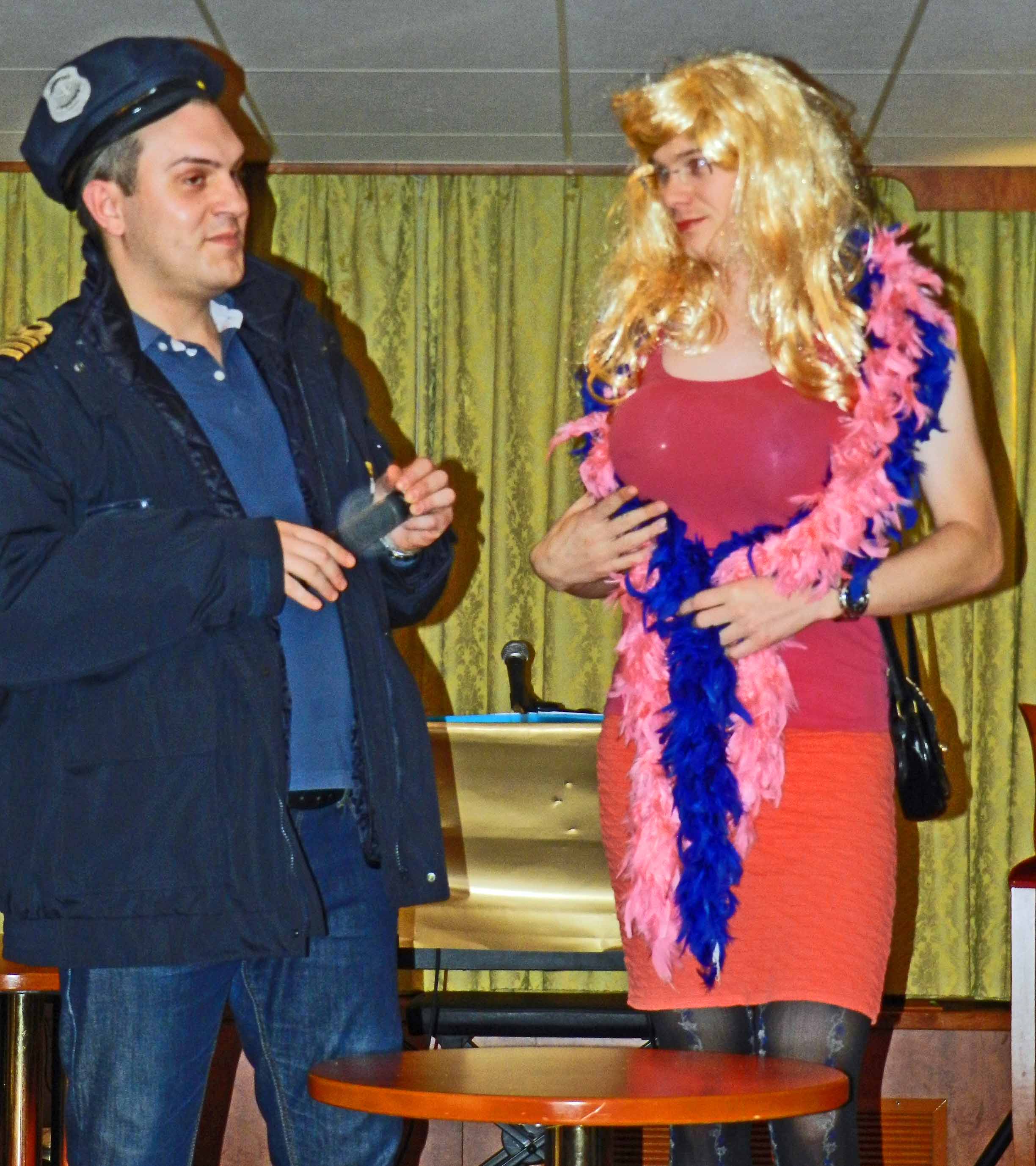
The crew
put on hilarious skits after dinner until we
laughed until our stomachs hurt, Some would
have been wonderful Boy Scout skits.


Tomorrow
we land in Budapest. I have heard it's a
beautiful city. I guess we'll see for
ourselves! It's been great fun on the boat.
We have met so many people. Since there are
only 160 guests, by the time we land in
Budapest we will have met most of them. Of
course our forty from the Blue Group and
Cheryl and Joan who moved to the green group
will be remembered most. We still keep in
touch by email with Cheng and IK from
Kentucky. Eight of us will be traveling
together with OAT to the coastal side of
Eastern Europe to visit more countries next
October.

























